
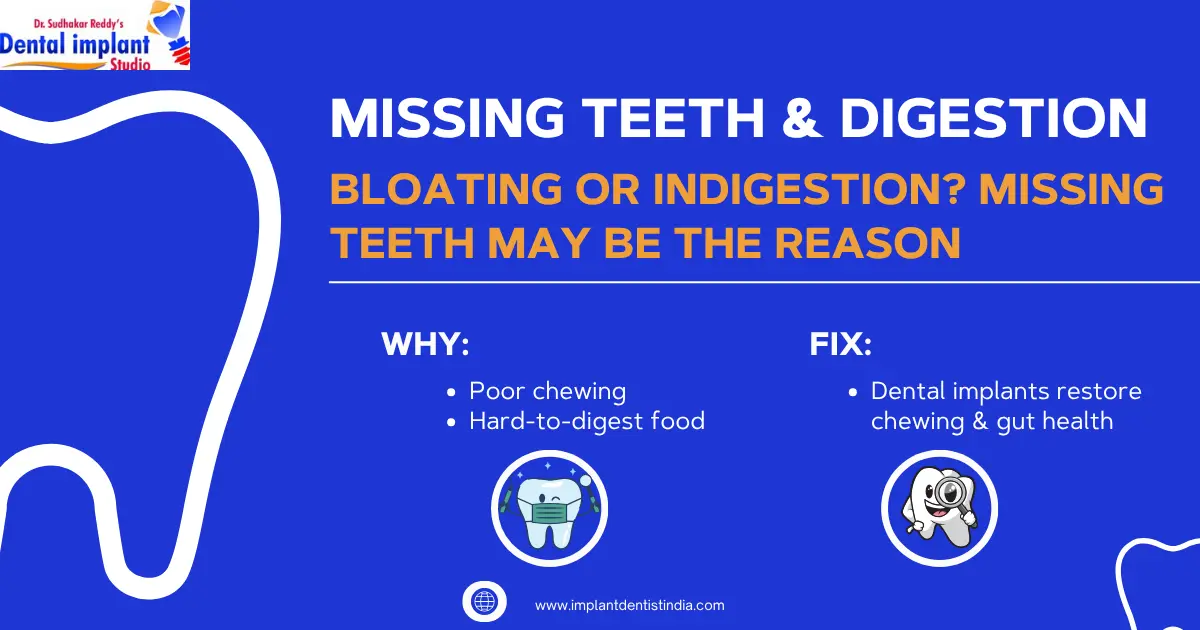
How Missing Teeth Can Lead to Digestive Problems
Have you ever experienced issues such as bloating, gas, or discomfort after meals, and wondered why? For most of us, the first thing is to blame our stomachs or the food we just had, but only a few realize that the problem might have started in our mouths. Yes, digestion starts in the mouth, where the initial breakdown of food happens, when teeth are missing, food isn’t broken down properly before reaching the stomach. This can lead to indigestion, nutrient deficiencies and overall discomfort. So a missing tooth do not only affect your smile and confidence, but also play a hidden role in how well your body processes food. No need to worry though, because this can be fixed
through timely dental treatments such as implants and bridges. Taking care of your oral health is the first step toward a healthier stomach.
The Connection between Oral Health and Digestion
Digestion starts in the mouth but, what does that really mean?
Let me explain- when the food is placed in the mouth the first steps of digestion begins right there. This is known as mechanical digestion, the process in which the teeth grinds and break down food into smaller particles. Simply known to us as chewing. At the same time, saliva mixes in to begin chemical digestion. When a tooth is missing, the food isn’t broken down fully, meaning that the rest of the digestive system has to work harder. Problems like indigestion usually traces back to improper chewing or bad oral health. In fact, poor oral health and digestion are connected through oral-gut
axis, where harmful bacteria and inflammation in the mouth can affect gut balance. Now let’s look at what happens when you have missing teeth.
What happens when you have missing teeth?
Teeth could be missing for various reasons such as gum disease, decay, aging or even trauma. Regardless of the reason behind the teeth loss, the effect it has on our body remains the same. Setting aside the thought of no longer being able to tear into your favourite dish (even though that would be tragic!), an impaired ability to chew food can have serious effects on your oral health and overall well-being.
Researchers have seen positive correlations between chewing ability and general health. Some have theorised that this is because your chewing ability has a big impact on your diet, which can then affect your broader health, but how? Loosing even a few of your back teeth can affect chewing power and bite alignment. This can reduce your ability to chew down fibrous and hard food, causes the remaining teeth to shift creating odd appearance and make us avoid nutritious foods such as fruits and vegetables, making us comfortable to soft processed food which aren’t healthy.
How Missing Teeth Affect Chewing and Digestion
As I have said, proper chewing breaks down food into small particles and mixes with saliva to ease digestion When there is teeth missing this breaking down process does not happen fully, resulting in larger- harder particles entering the stomach. This means the stomach is not able to fully breakdown the particles for the intestine to absorb nutrients, causing nutrient deficiency. The large particles can also cause bloating, gas and indigestion. Over time, poor chewing habits can weaken digestion and alter the gut microbiome.
The Role of the Gut Microbiome in Oral Health
Let us look at what the gut microbiome is, it is the trillions of micro-organisms- the bacteria, virus and fungi present in our digestive tract, especially in the intestine and helps us with digestion. Our mouth and gut share a bacterial network known as oral-gut axis, a missing teeth and poor oral health can lead to multiplication of harmful bacteria in our mouths and later they move down our digestive tract. This damages the balance of our gut microbiome, a condition known as dysbiosis. Once this occurs it can lead to various digestive issues such as IRB (irritable bowel syndrome), leaky gut, chronic inflammation and weakened immunity. Maintaining oral health support a stronger microbiome and stronger digestion.
Other Health Problems Linked to Missing Teeth and Poor Chewing
Now let’s pin point the problems caused by this:
Nutritional impact: as mentioned before, this can make us avoid fibrous food, we get essential vitamins like this A, C, D and B12 and also nutrient like fibrous protein from these foods. So reduced intake can lower the nutrient and vitamin levels in our body.
General health effects: problems like weakened immunity, fatigue and poor concentration due to malnutrition.
Psychological effect: avoiding certain food can lower our self-confidence, and cause social discomfort during meals because you are not able to eat like the rest.
This all shows us that it’s not just our physical body being affected, it also takes a toll on our mental and emotional health.
How Dental Implants Restore Chewing and Digestion
Dental implants can replace missing tooth and restore 90%-100% of natural chewing strength, it also prevents jaw bone shrinkage maintaining our facial structure, helping in better breakdown of food and enzyme activity, bring back our ability to have a balanced diet rich in nutrients, and also improve our overall oral health and microbiome balance.
There are also other options such as dentures and bridges but compared to dental implants they have drawbacks, these are not able to restore our natural chewing strength as well as dental implants and the dentures and bridges may not feel natural.
Tips to Prevent Digestive Problems after Tooth Loss
There are few ways in which we can prevent digestive problems after tooth loss, let us look into those:
- Replacing missing teeth early, getting early treatment can prevent digestive problems
- Practice daily oral hygiene, like brushing, flossing and using mouthwash
- Eating soft but nutrient dense food like smoothies
- Once restored, add fibre-rich foods, lean proteins, and probiotics.
- Chew food slowly and thoroughly — even with restorations.
When to Consult a Dentist
When you start having a hard time chewing or swallowing or you keep feeling bloated after meals, it could be your body trying to tell you something. Most times we just blame the food or our stomach, but sometimes the real issue starts right in the mouth. If you got few missing teeth, it makes chewing harder and your stomach ends up doing extra work to digest food that’s not properly broken down. After a while, this can lead to more gas, heaviness or just that uneasy feeling after eating. It might not sound like a big deal but it really adds up.
If you’re facing such problems, it’s best to consult an expert like Dr. Sudhakar Reddy K (BDS, MDS, FICOI, DICOI – U.S.A, and WCOI – Japan). He’s a well-known Oral & Maxillofacial Surgeon and Implantologist, recognized as a skilled surgeon, teacher, author and researcher in implantology. Dr. Sudhakar Reddy practices a full range of dental implant and oral surgical procedures and currently serves as Assistant Professor at Rajiv Gandhi Dental College & Hospital, R.T. Nagar, Bangalore, while also being
a Consultant Implantologist at Apollo White Dental Clinics across Bangalore. Visiting an experienced specialist like him can help restore proper chewing, improve digestion, and bring back the comfort and confidence you deserve.
Final Thoughts – A Healthy Smile Supports a Healthy Gut
In conclusion your oral health and digestion are more connected than you think. When you lose a few teeth, it quietly starts to mess with the way your body digests food. You might not notice it right away. When chewing gets harder, your stomach has to work overtime, and that can lead to bloating, gas or just feeling uneasy after meals. Over time, this can even affect your gut health and energy levels. Getting those missing teeth replaced with dental implants doesn’t just fix your smile, it helps your digestion work better too. So if you’ve been struggling with chewing or stomach issues, it’s a good idea to check with Dr. Sudhakar Reddy K and find out what’s best for you.